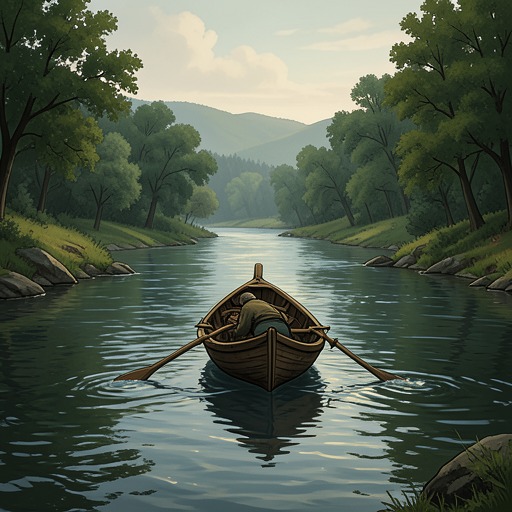
The Vico road goes round and round to meet where terms begin
Finnegans WakeThe Vico road is a recurring expression for circular time and return, making a road’s roundabout course an image of history and language coming back to their beginnings. Its clearest appearance accompanies Jaun’s declared mission to meet the king of Ireland, where the cyclical route gives his departure a broader, recurrent significance.
The road as a figure of recurrence
In Jaun’s farewell, the road goes round and round until it meets the place where terms begin. The sentence turns motion into a cycle rather than a straight passage from departure to destination. Jaun presents himself as setting out on a mission, yet the road’s return to beginnings complicates the promise of forward progress: the journey belongs to a world in which new beginnings can repeat old patterns.
The image echoes the novel’s opening movement, which travels from the shore and bay back to Howth Castle and its environs through a “commodius vicus of recirculation.” Read alongside that opening, the Vico road is not merely a route in a character’s speech; it is a compact model for the book’s larger return from ending to beginning.
A journey inside Jaun’s farewell
Jaun invokes the road while announcing that he is going to meet the overking of Ireland. He claims confidence in the mission and asks that his mother be told of it, making the image part of a personal leave-taking as well as a statement about historical cycles. The grand destination and the road’s circular shape pull in different directions: the journey sounds exceptional, but its form suggests that departure and return are bound together.
The words occur within Jaun’s extended address to the people around him. His elaborate, shifting speech ranges from private concerns to Ireland’s past and future; the Vico road briefly condenses that expansive performance into one memorable figure. Its circularity gives the announced mission a place in the novel’s recurring patterns without settling what its outcome will be.
Recurrence across the novel
Elsewhere, the narrative links history to “the same told of all” and describes a tale that is lost and told again. It also presents generations as continuing in a sequence of further generations. The Vico road resonates with these formulations: events and stories do not simply disappear but circulate, changing as they return. This association is reinforced by the novel’s multilingual, compound language, which repeatedly folds different sounds and meanings together rather than fixing them into a single, final sense.
The expression therefore joins physical motion, historical recurrence, and verbal form. A road seems to promise a destination; its loop instead makes the beginning part of the destination. In that tension between going forth and coming round again, the image offers a concise guide to the novel’s cyclical structure, while leaving each particular return open to variation.